 English
  Japanese
Our new findings published in Brain Topography reveal the millisecond-scale neural architecture of contemplative practice
In meditation, the mind can become noticeably quieter—with fewer thoughts, less distraction, and a more stable sense of awareness.
But what changes in the brain at that very moment?
…
The Question
At the 2025 Global Conference of Meditation Leaders in Delhi, All Here united with S-VYASA University, and Pyramid Valley International around a shared goal: understanding how meditation reshapes the brain at its most fundamental timescale.
Our study, “Microstate Dynamics of Focused Attention Meditati
on,” explores this at millisecond resolution—capturing the neural dynamics underlying shifts in attention and awareness. This is among the first published studies to capture EEG microstate dynamics in advanced meditation practice. Prior microstate research has largely focused on novice or short-term training paradigms, making the study of deep, stable contemplative states an important and underexplored frontier.
Using high-density 64-electrode EEG, we recorded brain activity from 22 experienced meditators practicing Ānāpānasati (classical breath-focused meditation) at Pyramid Valley International in Bengaluru, India.
We analyzed EEG microstates—brief, quasi-stable patterns of whole-brain electrical activity lasting 40–120 milliseconds. Think of them as the brain’s basic building blocks of cognition — just a few of these recurring states account for the majority of all brain electrical activity. The brain rapidly switches between these states, shaping our moment-to-moment thinking and awareness.
What we discovered provides unprecedented insight into how focused-attention meditation reshapes brain activity in real time.
…
Ānāpānasati: Breath Awareness Meditation
Ānāpānasati is a classical focused-attention technique from Buddhist contemplative traditions, described in the Ānāpānasati Sutta.
The practice: maintain sustained attention on the tactile sensations of breathing, typically at the nostrils or throughout the natural flow of inhalation and exhalation. When distractions arise—spontaneous thoughts, memories, emotional reactions—gently return attention to the breath.
This repeated cycle of focusing, noticing distraction, and reorienting strengthens sustained attention and meta-awareness (the ability to recognize when attention has wandered), progressively quieting self-referential mental activity.
…
The Experiment
Participants had 2 to over 20 years of meditation experience.
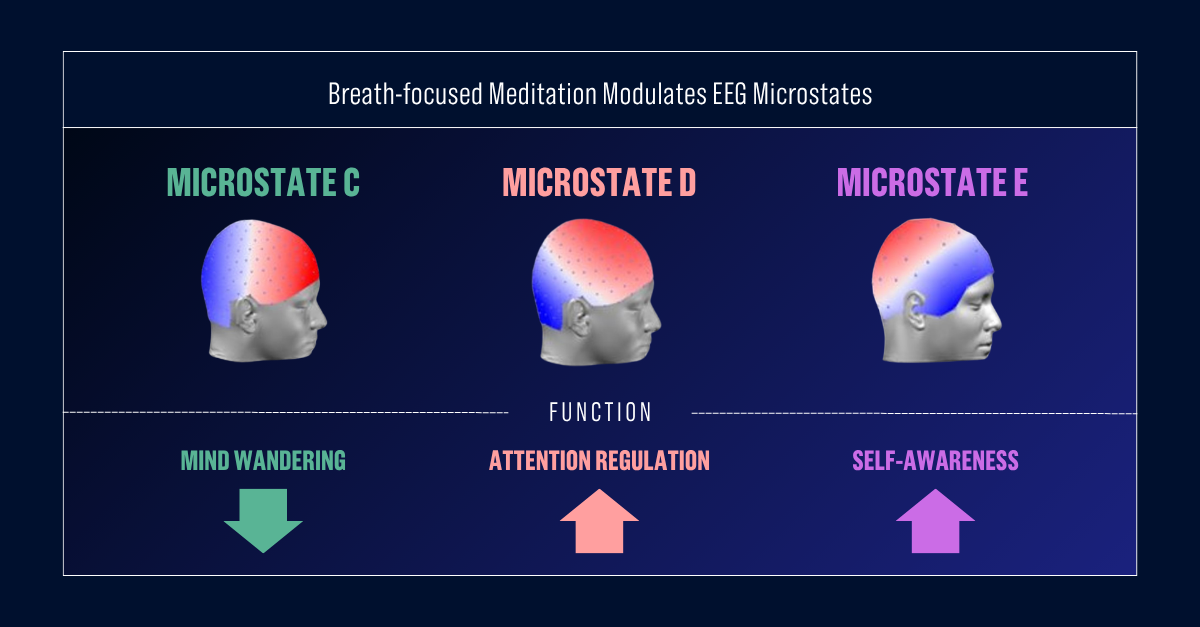
Simultaneously, patterns linked to attention regulation and self-awareness (Microstates D and E) increased significantly (all interactions p < 0.0001). Microstate D reflects attentional control, generated by the posterior cingulate cortex and precuneus. Microstate E captures three complementary dimensions of self-awareness — cognitive (dorsolateral prefrontal cortex), perceptual (temporoparietal junction and angular gyrus), and affective (orbitolimbic regions) — together supporting awareness of one’s own mental and bodily states.
Three conditions (eyes closed):
- Baseline rest (3 minutes): Participants sat quietly, allowing minds to wander naturally.
- Mental imagery (3 minutes): Participants vividly imagined a scene from memory.
- Meditation (20 minutes): Participants performed their usual Ānāpānasati practice.
We identified five canonical microstate classes (A through E) based on distinct spatial patterns of electrical activity, then quantified three temporal parameters: duration, occurrence, and coverage — revealing not just which networks are active, but how long and how often each configuration dominates brain activity.
…
The Findings
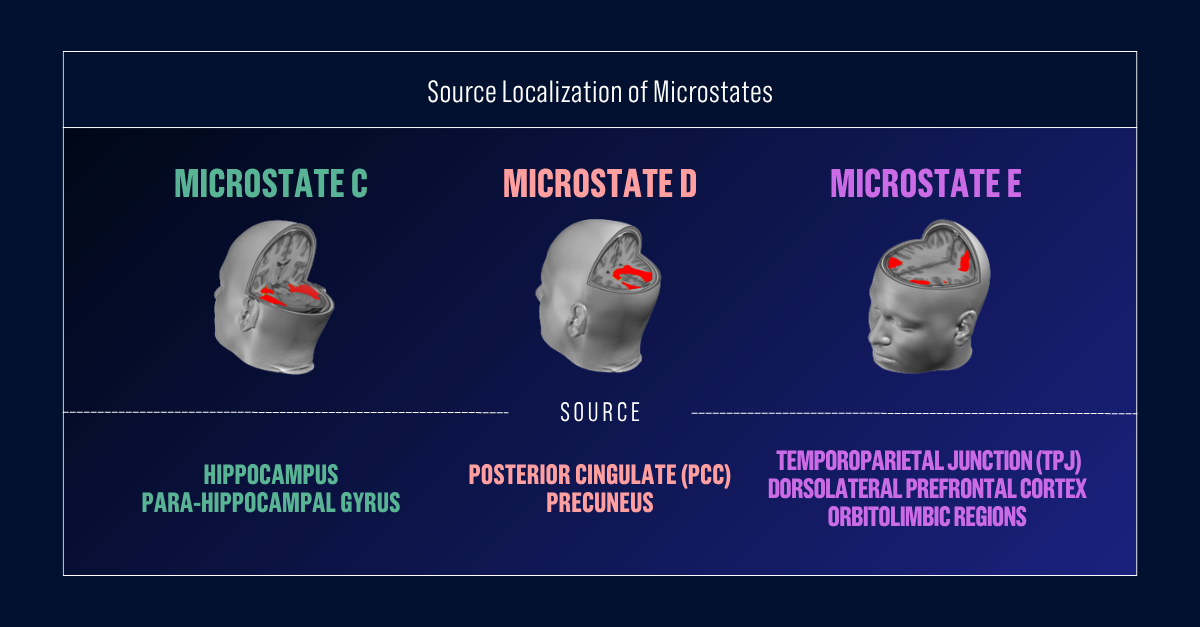
During meditation, one pattern dropped dramatically: Microstate C, generated by mind-wandering and memory-related brain regions (hippocampus, para-hippocampal gyrus. medial temporal gyrus)—the neural signature of mind-wandering.
…
Microstate C: The Neural Signature of Mind-Wandering
Where it comes from: brain centers for reliving the past and imagining the future—the hippocampus, parahippocampal and medial temporal gyrus.
What these regions do: When you’re replaying yesterday’s conversation or imagining next summer’s vacation—that’s these regions at work. They handle episodic memory and autobiographical thinking about the past and future.
What this means: Microstate C has been linked to the default mode network associated with spontaneous mental activity during mind-wandering. Its reduction during meditation provides a neural signature of decreased mental chatter—reduced engagement in memory-based, self-referential thinking.
Translation: The brain spends less time lost in autobiographical memory and more time anchored in the present moment.
…
Microstate D: The Neural Signature of Sustained Attention
Where it comes from: brain’s attentional regulation centers including the posterior cingulate cortex (PCC) and precuneus.
What these regions do: support sustained, regulated attention—the capacity to stay focused in the face of potential distractions.
What this means: Its increased presence during meditation suggests that experienced practitioners recruit these brain areas to maintain focused attention on the breath at the nostril—and facilitates redirecting attention when distraction occurs.
Translation: The brain actively maintains focus on the meditation object and efficiently redirects attention when it wanders—like a skilled conductor keeping the orchestra in sync.
…
Microstate E: The Neural Signature of Self-Awareness
Where it comes from: brain regions involved in self-awareness of our own mind and body—including the temporal parietal junction, the dorsolateral prefrontal cortex and orbitolimbic brain regions.
What these regions do: The brain’s “self-monitoring system,” helping you to become aware of your own thoughts and experiences. They bring together the body’s internal signals—breath, physical sensations, emotions—with ongoing mental experience, forming the neural basis of inner self-awareness. In meditation, these regions allow the practitioner to witness their own experience as it unfolds in the present moment.
What this means: When Microstate E increases during meditation, this suggests increased awareness of both one’s own mental and/or physical states.
Translation: The brain isn’t just thinking or just paying attention—it’s aware that it’s paying attention, monitoring the cognitive, emotional, and bodily aspects of that awareness.
…
The implications
The bottom line: Focused meditation reshapes the architecture of large-scale brain states, shifting away from spontaneous mental chatter toward networks of sustained attention and inner awareness.
By operating at millisecond resolution, microstate analysis captures brain networks during meditation at the timescale where conscious experience actually unfolds—revealing not just that focused-attention meditation doesn’t simply quiet the brain, but that it actively reorganizes how large-scale brain networks coordinate over time.
Our source localization results suggest that default mode network subsystems may be differentially reflected in distinct microstates:
- Microstate C corresponds to the medial temporal subsystem (memory centers),
- Microstate D appears linked to posterior cingulate cortex activity (attention regulation),
- and Microstate E aligns with regions supporting self-awareness (self-monitoring networks).
This mapping implies that meditation may reorganize interactions within the default mode network rather than simply suppressing it globally.
…
Mapping the neural signature of Ancient Practice
This research demonstrates how contemplative practices cultivated over millennia can be rigorously characterized using contemporary neuroscience methods.
A recent systematic review (Lieberman et al., 2025) highlights substantial inconsistencies in existing focused-attention meditation research. The authors emphasize that conclusions based solely on electrode-level power measurements may be misleading, as the location of EEG signals on the scalp do not reliably reflect the source of their underlying neural generators within the brain.
They recommend that future research incorporate spatially informed methods—such as EEG microstate analysis and source localization techniques—to better characterize the neural mechanisms supporting focused attention.
Our study follows this recommendation, providing a mechanistic account of the neural processes underlying focused-attention meditation that bridges methodological rigor with contemplative traditions.
By establishing measurable benchmarks for meditation practice, we can make contemplative training more accessible while illuminating the remarkable capacities of human consciousness.
Science is now offering a neuroscientific window into what meditators have described for millennia: sustained attention training fundamentally changes how the mind operates.
…
Outstanding Cooperation
We are grateful to our co-authors, Dr. Amit Kanthi and Dr. NK Manjunath of S-VYASA University; to our research partners at Pyramid Valley International, who provided the meditation center facilities and participant recruitment; and to our team members: Dr.-Ing. Chuong Ngo, Erkin Bek, Monika Stasytytė, Dr. Lionel Newman, Rodrigo Elizalde, and Prof. Christoph Michel.
This collaboration bridges classical contemplative practice (rooted in the Ānāpānasati Sutta) with modern EEG neuroscience, uniting expertise in meditation, neurophysiology, and signal processing.
…
Explore Further
Read the full peer-reviewed in Brain Topography
Join our research program → Contact us at welcome@allhere.org
Subscribe to our newsletter for updates on meditation neuroscience
Inspire to Meditate with Science and Technology.