ALLHERE
PRACTICE
SCIENCE
TECHNOLOGY
Skip Intro

Invitation to Participate in Research

All Here Meditation Institute invites you to participate in our meditation research program.

Please review this Consent Form carefully. You will be asked to sign it in person on the day of your session.

Important:

– This Consent applies only to participation in the All Here Meditation Research Program.
– The Terms and Conditions you previously accepted apply to participation in the meditation session itself and are separate from this research consent.

Prefer to sign in advance?
Download the Consent Form by clicking on the link below, print, sign, and send it to welcome@allhere.org

Download All Here Study Participation Consent Form (PDF)


Consent Form- Review Copy

Your participation is entirely voluntary.
All data collected as part of this project is subject to strict data protection regulations.

The research project is conducted by All Here SA. We will communicate the results to you if you wish.

During an interview, we will present the essential elements and answer your questions. To give you an initial overview of the project, here are the key points to remember. You will find more detailed supplementary information below.

1. Why are we conducting this research project ?

– Meditation is associated with numerous benefits for mental and physical health, but we still poorly understand how it acts on the brain.
– Our research project aims to determine how different meditation techniques modify the electrical activity of the brain.
– We wish to compare the effects of meditation between beginners, intermediate practitioners, and experts.

2. What do I need to do if I agree to participate? – What happens to me if I participate? Form of participation ? 

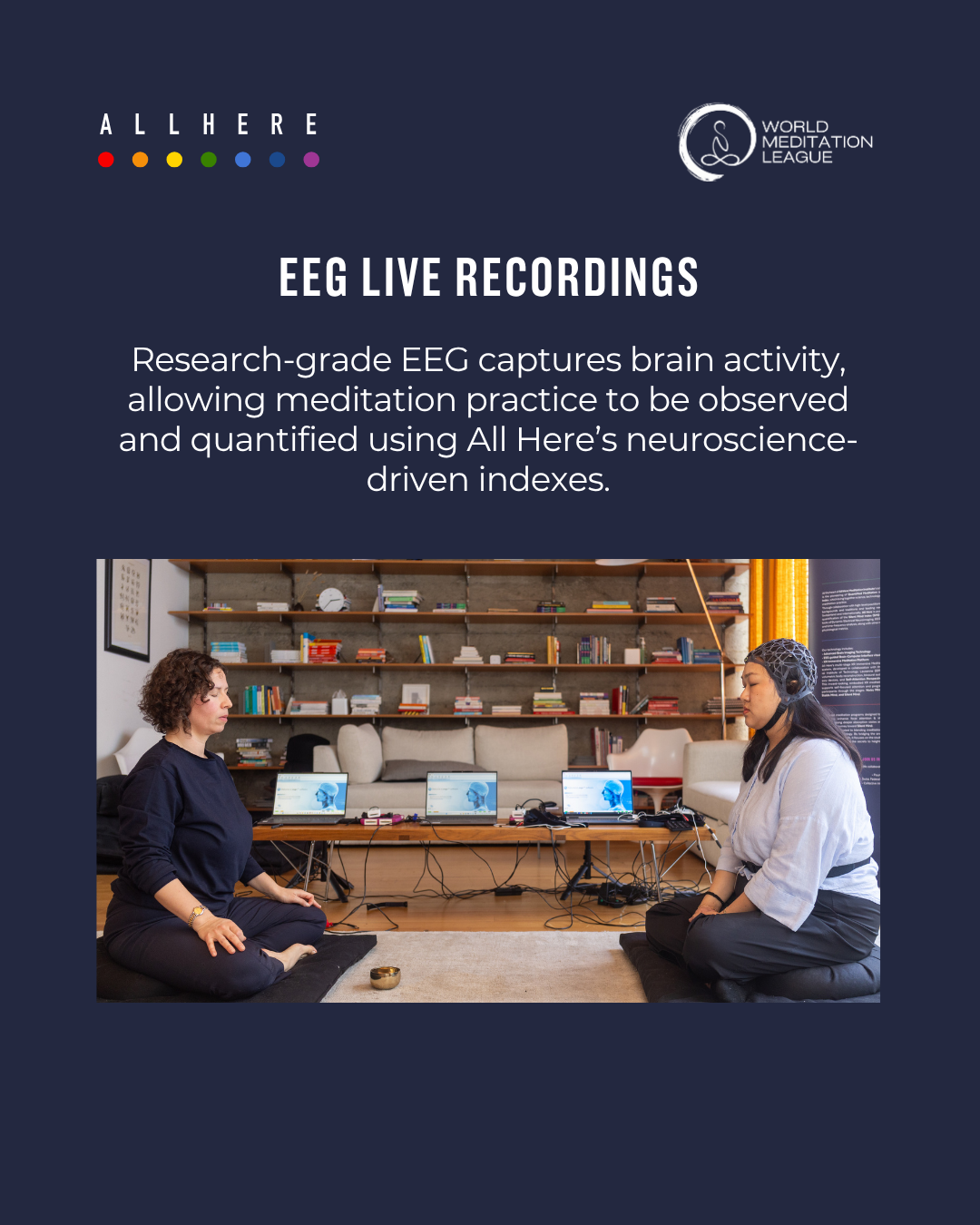
If you agree to participate in our project, you will come to our laboratory once for approximately 2 hours. We will record your brain activity (EEG), heart rate, breathing, and skin activity (perspiration) while you practice meditation.

Process for you:
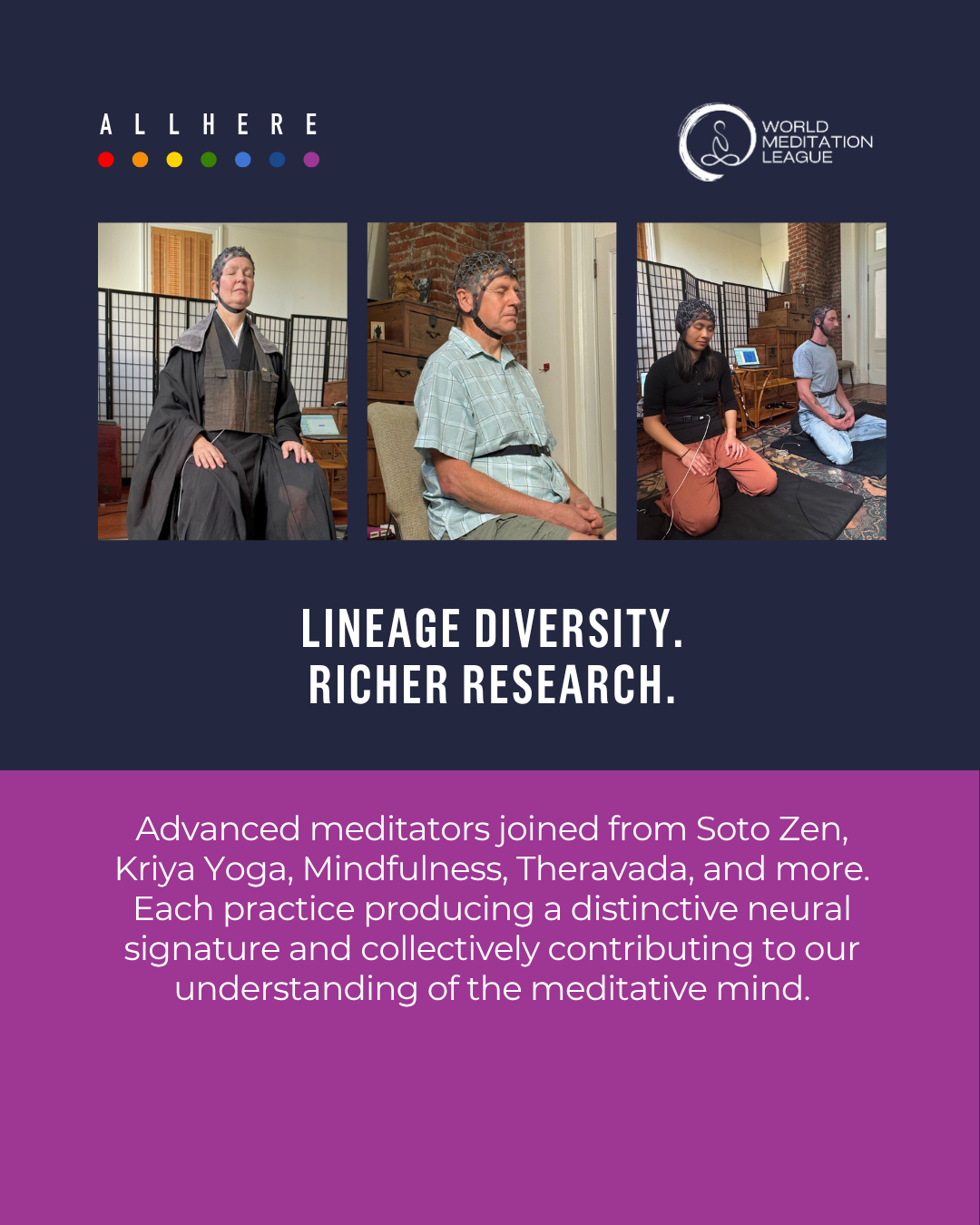
– Installation of a net with electrodes on your head (non-invasive, no needles)
– Rest periods and guided meditation sessions (approximately 1 hour of recording)
– Questionnaires about your experience
– No follow-up visits

3. What are the benefits and risks associated with participating in the project ?

Benefits:
– You will discover guided meditation techniques
– You will contribute to advancing scientific research on meditation
– Your participation will not provide any direct therapeutic benefit.

Risks and constraints:
– The risks are minimal: slight discomfort from the EEG net, wet hair, time commitment
– Possible fatigue related to concentration

By signing at the end of the document, you certify that you have understood its content and freely consent to take part in the project.

DETAILED INFORMATION

1. PROJECT OBJECTIVE AND PARTICIPANT SELECTION
In this information sheet, our research project is also simply referred to as the project. If you agree to take part, you are a participant in the project.

What do we already know?

Meditation has been practiced for millennia and recent studies show that it can improve mental well-being, reduce stress, and modify brain function. However, we still know little about the precise mechanisms by which meditation produces these effects.

What do we wish to discover?

We wish to identify specific electrophysiological signatures (patterns of electrical brain activity) associated with different meditation techniques. We want to understand how the brain changes during meditation and how these changes differ according to the meditator’s level of experience.

Why are we asking you to participate?

We are soliciting you because you meet the participation criteria. You are:
– For novices: A person beginning meditation, interested in discovering this practice.
– For intermediate: A person with beginner experience in meditation.
– For experts: An experienced meditator with regular practice.

_______________________________________________________________________________

 2. GENERAL INFORMATION ABOUT THE PROJECT

Type of study:

This study is a non-interventional observational research project. We simply record your brain activity while you practice meditation. There is no treatment, no medication, and no medical intervention.

Duration and participants:
– Your participation: A single visit of approximately 2 hours
Total project duration: Approximately 4-5 years
Number of participants: 150 people in total:
– 50 novice meditators (Switzerland)
– 50 intermediate meditators (Switzerland)
– 50 expert meditators (Switzerland and abroad)

Type of study:
Monocentric (coordinating center in Geneva), with international recruitment for experts

Legal and ethical framework:

This project is carried out in compliance with the provisions of Swiss legislation (Federal Act on Research involving Human Beings – HRA). We also follow all internationally recognized guidelines. The Geneva Cantonal Research Ethics Commission (CCER) has reviewed and authorized this project.

_______________________________________________________________________________

3. PROJECT PROCEDURE

This is a single visit to the laboratory (approximately 2 hours)

Step 1: Welcome and preparation (30-40 minutes)
a. Signing of the consent form (if you have not yet decided)
b. Questions about your meditation experience and lifestyle habits
c. Verification of inclusion/exclusion criteria
d. Installation of recording equipment:
– EEG net with 64 electrodes equipped with sponges soaked in salt water
– 2 adhesive electrodes on the chest for heart rate (ECG)
– Respiratory belt around the thorax or abdomen
– 2 electrodes on the fingers to measure skin activity (perspiration)

Step 2: Recordings (approximately 60-70 minutes)

You will be seated comfortably in a quiet room. A member of the research team will be present in the same room with you.

For novice and intermediate participants:
1. Rest eyes closed (5 minutes): Remain quietly seated, eyes closed
2. Rest eyes open (5 minutes): Fix your gaze on a point in front of you
3. First guided meditation (20 minutes): Audio instructions [concentration OR open observation, according to randomization]
4. Questionnaire on the effect of meditation
5. Rest eyes closed (5 minutes): Remain quietly seated, eyes closed
6. Second guided meditation (20 minutes): Audio instructions [the other type of meditation]

The order of the two types of meditation is randomly determined to avoid bias in the results.

For expert participants:
1. Rest eyes closed (5 minutes)
2. Rest eyes open (5 minutes)
3. Your usual practice (20-40 minutes): You practice your own meditation technique
4. Questionnaire on the effect of meditation

Optional: If you agree, two guided meditation sessions (like for novices)


Step 3: End of session (15-20 minutes)
– Removal of recording equipment
– Cleaning/drying of hair if necessary
– Questionnaire about your experience during meditations
– Brief interview about how you felt (with your agreement, this interview may be audio recorded)

During recordings:

You can interrupt at any time by speaking or raising your hand. You are free to stop your participation without justification.

We may need to exclude you from the project before the planned end.

This situation may occur if we discover an exclusion criterion not previously identified, or in case of a major technical problem preventing the collection of quality data.

_______________________________________________________________________________

 4. BENEFITS

Your participation in the project will not provide you with any direct therapeutic benefit.
This study is conducted for scientific research purposes and not for treatment or diagnosis.

Potential benefits for you:

– Discovery of guided meditation techniques [for novices and intermediate]
– If you wish, general feedback on your brain activity
– Contribution to the advancement of scientific knowledge

Benefits for science:

The results of this research could prove important for:
– Understanding the neural mechanisms of meditation
– Developing meditation-based interventions for mental health
– Advancing contemplative neuroscience

_______________________________________________________________________________

 5. VOLUNTARY NATURE OF PARTICIPATION AND OBLIGATIONS

Your participation is entirely voluntary

If you choose not to participate or if you choose to participate and change your mind during the course of the project, you will not have to justify yourself. This decision will have no unfavorable repercussions on the continuation of your medical care or on your relations with the institution or the researchers.

If you choose to participate, you will be required to:
– Follow the instructions during recordings (remain seated, not move during certain periods, follow meditation instructions)
– Inform us of any discomfort or inconvenience during the session
– Answer questionnaires honestly

_______________________________________________________________________________

6. RISKS AND CONSTRAINTS

By participating in the project, you will only be exposed to minimal risks. Electroencephalography (EEG) is a non-invasive method widely used in research and clinical practice.

Slight physical discomfort
– Slight pressure sensation from the EEG net on the scalp
– Scalp and hair moisture due to salt water in the sponges
– Wet hair requiring drying after net removal
– Possible slight temporary skin irritation at contact points (disappears quickly)

Fatigue

– Possible fatigue related to prolonged concentration for approximately 2 hours

Constraints
– Time commitment (approximately 2 hours)
– Need to remain relatively still during recordings
– Questionnaires to complete

Safety measures:
– A team member is present with you in the room
– You can stop at any time
– Sterilized equipment;
single-use electrodes when necessary

What to do in case of discomfort?

Inform the research team immediately. The session will be interrupted if necessary.

_______________________________________________________________________________

 7. ALTERNATIVES

If you do not wish to participate in this research project, this will have no consequences for you.

This study is not therapeutic in nature. Therefore, there is no medical “alternative” to your participation. If you are interested in meditation, you can learn it through other means (courses, applications, books, etc.).

_______________________________________________________________________________

8. RESULTS

The project allows for different results to be obtained:

  1. Individual results concerning you
    During the project, if we discover important information concerning your health, you will be informed. You can then decide whether you wish to continue your participation in the project.Important note: This study measures brain activity during meditation for research purposes. EEG recordings are not medical diagnostic examinations.
  1. Incidental findings
    It is very unlikely that we will discover something unexpected about your health during this study. The EEG we use is intended for research and not for medical diagnosis.
    If, by chance, we observed something concerning in your recordings, we would inform you and recommend that you consult a physician.
    If you do not wish to receive this information (“right not to know”), please indicate this to the investigator.
  1. Overall project results
    At the end of the project (generally 1-2 years after the end of data collection), we can send you a summary of the overall results if you wish. The results will also be published in scientific journals.

_______________________________________________________________________________

 9. CONFIDENTIALITY OF DATA AND SAMPLES

9.1 Data processing and coding

As part of this research project, data relating to your person and your health are collected and processed, partly in an automated manner.

Data collected:
– EEG data (electrical brain activity)
– Physiological data (heart rate, breathing, electrodermal activity)
– Questionnaire responses
– Audio recordings of interviews (if you consent)
– Demographic information (age, sex)
– Information about your meditation practice

Immediate coding:

This information is coded at the time of collection. Coding means that all data allowing you to be identified (name, date of birth, contact details) are replaced by a code (unique identification number). It is not possible to link the data to your person without the code, which remains permanently within the institution.

Access to data:

Only a limited number of people can view your data in an uncoded form, and only in order to accomplish tasks necessary for the conduct of the project. These people are:
– The principal investigator (Prof. Christoph Michel)
– Authorized members of the research team
– These people are bound by professional secrecy.

Your right to access:

As a participant, you have the right to access your data at any time.

9.2 Protection of data and samples
All directives relating to data protection are strictly respected.

Secure storage:
– Coded data are stored on a secure server (Interhyve data center, Satigny, Switzerland)
– Strict IT security measures (encryption, firewall, backups)
– Access limited to authorized team members

Retention period:
– Identifiable personal data: Destroyed immediately after coding
– Correspondence table (link between your identity and your code): Kept separately in a secure manner by the principal investigator for 10 years, then destroyed
– Coded data: Kept for 10 years after the end of the study

Data sharing:

Your data may need to be transmitted in coded form, for example for a publication, and may be made available to other qualified researchers for secondary scientific analyses. These shares will only occur within the framework of research projects approved by an ethics commission and with appropriate confidentiality guarantees.

No biological material is collected in this study (no blood samples, no specimens).

9.3 Data protection in case of reuse

Your coded data could later prove important for answering other research questions about meditation and the brain. They could be used in other research projects (reuse) or sent to a data bank located in Switzerland or abroad. This data bank must, however, comply with the same standards and requirements as those of the present project.

For this reuse, we ask you to sign a separate consent declaration at the end of this information sheet. This second consent is independent of participation in the project.

Audio recordings of interviews will be transcribed into text with only the participant code as an identifier. The original audio files will be securely destroyed after verification of the transcription. Only anonymized transcriptions will be kept for qualitative analysis and will not be shared publicly.

9.4 Right of inspection in the context of inspections

The project may be subject to inspections. These may be carried out by the competent ethics commission or by the sponsor who initiated the project (All Here SA). The investigator must then communicate your data for the purposes of these inspections. All persons involved are bound to the strictest professional secrecy.

_______________________________________________________________________________

 10. WITHDRAWAL FROM THE PROJECT

You can withdraw at any time

You can withdraw from the project at any time if you wish, without having to justify yourself. You simply need to inform the principal investigator (Prof. Christoph Michel).

What happens to your data if you withdraw?

First option – Data kept in coded form:

The data already collected and coded can still be analyzed in coded form. This ensures the scientific validity of the study and the protection of your data. You must therefore agree to this before giving your consent.

Second option – Destruction:

If you explicitly request it at the time of your withdrawal, we can destroy your data and anonymize the code linking you to this data.

Important note: Once the data is completely anonymized (code destroyed), it will no longer be possible to identify or delete it.

_______________________________________________________________________________

11. REMUNERATION

You will not receive any remuneration for your participation in this research project.

Justification:

Novice and intermediate participants benefit from free initiation to guided meditation. For expert participants, the participation burden remains modest (a single session) and the main motivation is contribution to scientific research.

Reimbursement of expenses:

Transportation costs (public transport or parking) that arise directly from your participation in the project will be reimbursed upon presentation of receipts.

No cost to you:

Your participation will have no financial consequences for you or your health insurance.

Intellectual property:

In some cases, the results of this project may help develop commercial products. If you consent to participate in this project, you simultaneously waive all rights to commercial exploitation (arising from patents in particular).

_______________________________________________________________________________

 12. LIABILITY

All Here SA, which initiated the research project and is responsible for its implementation, is liable for damage you might suffer in connection with the project. The conditions and procedure are set by law.

All Here SA has concluded liability insurance in accordance with Swiss legislation on research involving human beings in order to be able to compensate for damage for which it is liable.

In case of damage:

If you should suffer damage as a result of your participation in the project, you should contact the principal investigator (Prof. Christoph Michel) immediately.

Insurance contact details: Vaudoise Assurance, Rue des Charpentiers 9, 1110 Morges. Tel 021 804 74 00

_____________________________________________________________________________

 13. FUNDING

The project is entirely funded by All Here SA.

All Here SA is a private institute/company. Prof. Christoph Michel holds the position of “Chief Neuroscientific Director” at All Here SA as part of a consultancy contract. All Here SA also provides the necessary infrastructure for EEG recordings.

The scientific integrity of the study is guaranteed. The researchers commit to conducting the study according to the strictest scientific standards and to publishing all results.

 _______________________________________________________________________________

 14. CONTACT PERSON(S)

You can ask questions about the project at any time.

Principal Investigator:
Prof. Christoph Michel
All Here SA
Clos Belmont 12
1208 Geneva
Telephone: 079 689 67 89
Email:christoph.michel@allhere.org
Available Monday to Friday, 9am-5pm

For questions about your rights as a participant:
Geneva Cantonal Research Ethics Commission (CCER)
Telephone: 022 546 51 01
Email: ccer@etat.ge.ch

In case of medical emergency:
Emergency number in Switzerland: 144

en_GBEnglish